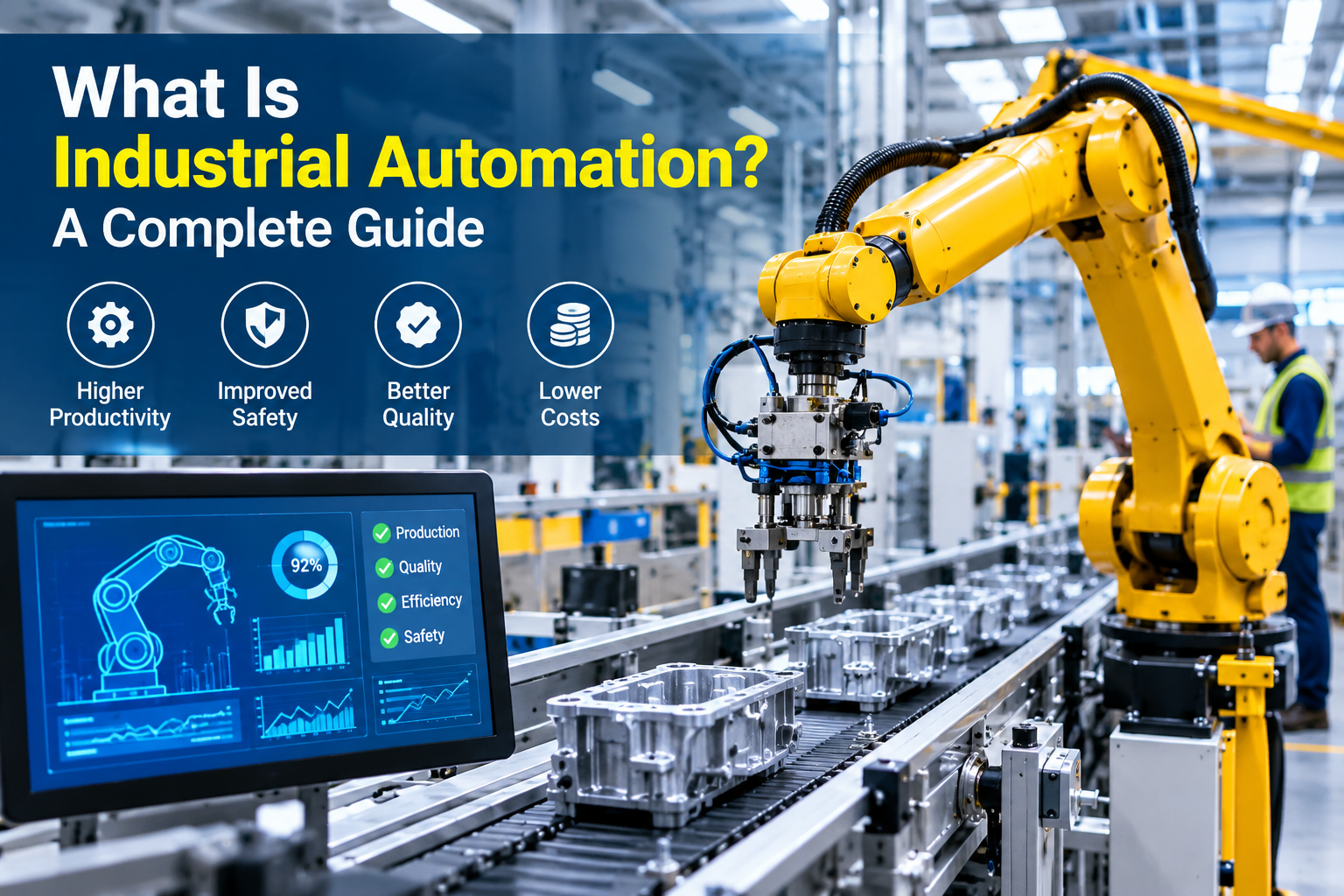
What Is Industrial Automation? A Full Guide
Automation is becoming the new reality for factories, warehouses and production plants. Rather than replacing the worker, automation allows companies to automate some functions, automation speeds up production, enhances quality and minimizes hazards in the work environment.
What Is Industrial Automation and How Does It Work?
Industrial automation refers to the hardware and software used to control equipment, monitor processes, and manage production. Some automation system perform simple repetitive functions, while others oversee entire buildings.
E.g., a beverages factory may rely on sensors to identify empty bottles, conveyor belts to carry them around, and automated filling and capping systems to fill and seal individual bottles.
Main Components of Industrial Automation
The following essentials are commonly present in most industrial automation systems:
- Sensors: Detect temperature, pressure, speed, and other operating environments.
- Controllers: They process informations and then, transmit commands to machines.
- Actuators: Can be found controlling: Valves, motors, robotic joints and other mechanical components.
- Human-machine interfaces (HMIs): Enable operators to view equipment status and control their parameters.
- Industrial software: Records production data, monitors efficiencies, and aids in problem identification.
These elements are designed to ensure the production activities are well maintained, repeatable and able to produce results economically.
Four Types of Industrial Automation
Variety of industries requires varying levels of automation. Which automation level is better? It depends on the number of product units, product variety, budget, and other factors.
1. Fixed Automation
Fixed automation involves the repetitive use of equipment designed to perform the same task. Examples include bottling plants, and the production lines of car factories.
The advantage of this is quick, consistent production. And of course, moving from one product to another, or to a different process, can mean costly equipment upgrades.
2. Programmable Automation
Programmable automation means the operators are able to alter the instruction set of the machine for different batches or types of product. This is especially useful for a business that produces many types of products.
Suppose a metalworking shop might reprogram its automated presses to manufacture different sized components.
3. Flexible Automation
Flexible automation involves the ability to change between product types with minimal manual intervention. Computer-controlled manufacturing systems and programmable robots may be used.
It is especially helpful when the customer requirements change often and vendors have to make several different items economically.
4. Integrated Automation
Integrated automation links production computers, monitoring and business systems together in one environment.
That could take the form of a manufacturing execution system providing production data to inventory application, giving managers insights on material status and stage of progress.
7 Essential Benefits of Industrial Automation
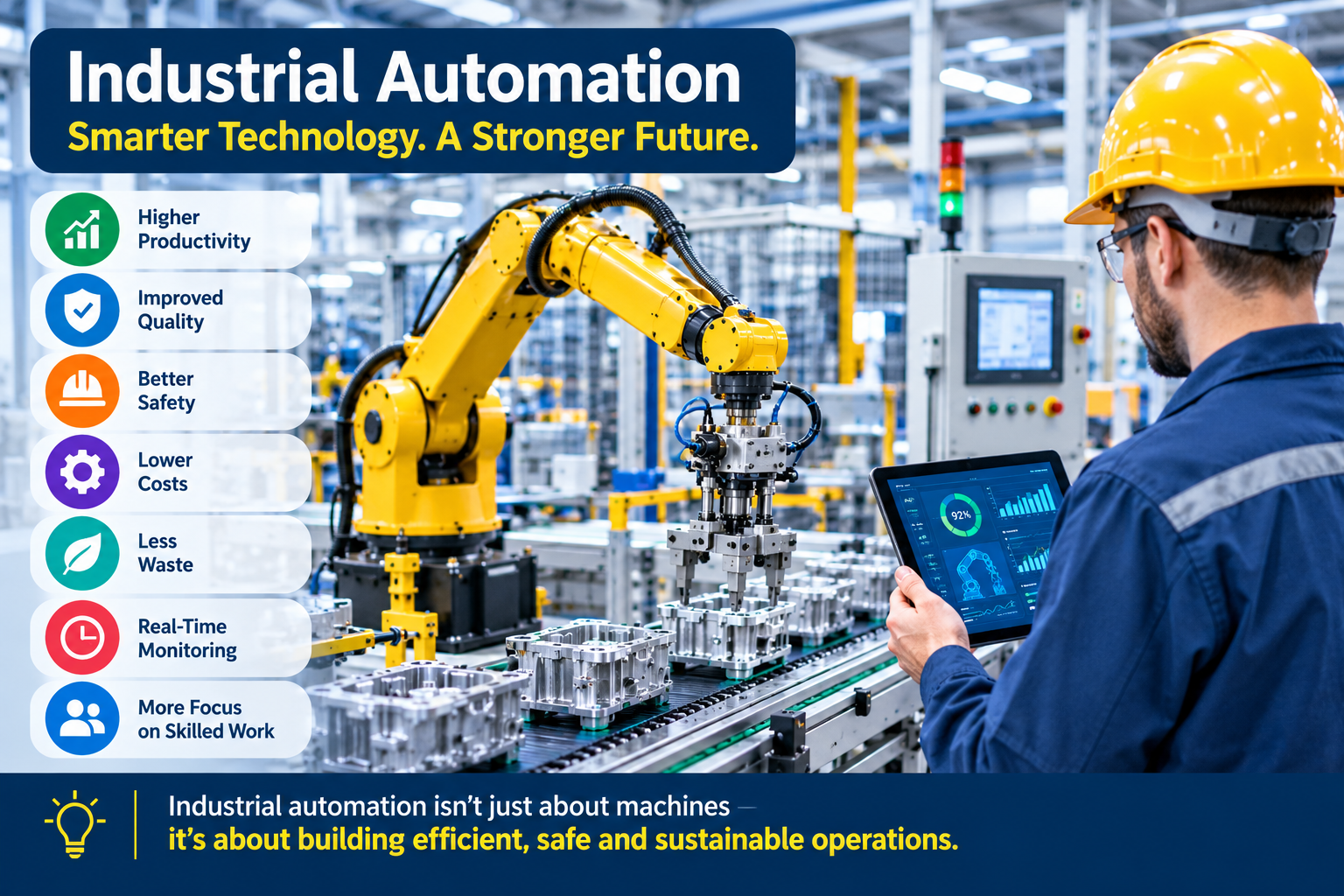
There are many benefits of automation in industrial processes.
- Increased productivity: Speed and quality are two advantages of machines that can repeatedly perform the same operation.
- Better control over production processes reduces the number of variations, and detects defects when they occur.
- They can work with dangerous substances and perform repetitive dangerous tasks.
- With the right measurements, you can save on materials and manufacturing errors.
- Standard operation: Automated processes can produce consistent operation.
- Monitoring in real time: sensors and software help problems with equipment to be detected at an earlier stage.
- Skill utilization: employees to concentrate on supervising, maintenance, troubleshooting and process development.
Yet automation comes with equipment costs, employee training, cybersecurity threats and ongoing maintenance. Be sure to assess these aspects before rolling out automation solutions.
An effective case for automation addresses a specific, quantifiable improvement in your operations. Forcing large investments without tracking the gains that materialise will add to your expenses.
How to Automate Business Processes Successfully
By knowing how to automate processes, it can help your factory take out some inefficiencies when it comes to production. It can be applied to inventory management, order processing, quality reports, and repairs of equipment.
Follow these practical steps:
Step 1: List out Repetitive Tasks
Begin by identifying the tasks that are time-consuming, repetitive, and error-prone. Tasks such as the following: counting products, entering production records, weighing packages, etc.
Step 2: Measure Current Performance
How long each activity takes, how many errors are made and the amount of work or materials involved in performing it. This data provides a starting point for measuring progress.
Step 3: Select the appropriate Technology
Choose equipment and software to fit the task. A simple sensor may solve a monitoring problem, but you may need a robot system for repetitive material handling.
Step 4: Conduct a Small Pilot Project
Test one machine, production line or business process with this solution at a time. Test reliability, safety, maintenance requirements and compatibility to current equipment.
Step 5: Train Employees and Track Results
Instruct staff how to use, control and troubleshoot the system. Feed back performance compared to the initial measurements, and refine the procedure as appropriate.
What Is an Example of Intelligent Automation?
Intelligent automation is the integration of automation tools with artificial intelligence (AI), machine learning, and/or computer vision. This is different from automation, which is rule-based and knows what to do, but cannot analyze information or assist with decision-making.
For instance: a product inspection in the factory. A camera takes shots of a manufactured object and an AI model looks for potential cracks, scratches, wrong shape, or other anomalies. The machine can then mark those for inspection.
This method may assist manufacturers when inspecting large volumes of products for uniformity. The outcome, though, is subject to factors like image quality, the amount of data on which the system has been trained, operating conditions, and human supervision.
What Is Automation in Healthcare?
Automation is a process of using technology in healthcare to automate clinical, administrative and laboratory processes. The goal is to enhance workflow performance, eliminate preventable errors, and support the healthcare professional, of managing information and equipment.
Examples include:
- Laboratory automation: Samples are processed and analyzed by automated machines under preset parameters.
- Medications dispensing: Automated systems assist with controlling the storage and dispatch of medications.
- The system manages appointments, reminders, and patient notifications.
- Medical equipment monitoring: Sensors monitor the conditions of the equipment and notify staff of potential issues.
Automation of healthcare must keep patient privacy, technical accuracy, and clinical safety a high priority. Make sure the machine generated recommendations won’t override real clinical decision-making when a healthcare professional is needed.
Industrial Automation vs. Smart Automation
While they are related, these terms are describing other features.
| Feature | Industrial Automation | Intelligent Automation |
|---|---|---|
| Main Objectives | Operate machinery and production lines | Automate tasks through analysis of data |
| Standard Technology | PLC, sensors, robotics | AI, ML, computer vision |
| Example | Automated bottle filling | AI-powered defect detection |
| Human involvement | Setup, maintenance, oversight, validation, exception handling |
One factory could integrate both approaches by operating their machinery with industrial controllers and will run AI software which should be able to detect quality issues.
Challenges and Best Practices
Automating is not just about buying new equipment. If you do not plan properly, it can lead to unneeded downtime, integration issues and costs.
Businesses should address these challenges by following several best practices:
- Safety first: Perform a risk assessment and select guards, emergency stops, and safety devices as necessary.
- Plan regular inspection time or exchange imperfect parts before they break down, do not affected production.
- Control access to connected systems: Implement access controls, software updates, network segmentation and cybersecurity protocols.
- Train employees: Make sure workers are taught how to operate equipment and what to do in an emergency.
- Assess return on investment: Weigh the costs of implementing the technology against reported improvements in productivity, quality and downtime.
Small companies will be able to get started with just one process that delivers a strong impact, then scale as they witness the benefits of their efforts.
Conclusion
Industrial automation allows businesses to regulate their manufacturing processes, enhance product consistency, minimize waste, and shield workers from some of the more dangerous processes.